7 December St. Ambrose of Milan, Doctor and Very Cool

Today is the feast of St. Ambrose.  I have a 1st class relic in the Two Trinities Chapel, so he is, in a sense, a homie.

St. Ambrose of Milan (+4 April 397), was a titanic figure of the late 4th century who changed the shape of Church and State relations for a thousand years.  He brought much of the wisdom of Greek writings to the West. He helped God bring St. Augustine of Hippo into the fold.

There are many things to write about Ambrose.  Here are a few.

Legend has it of baby Ambrose that once when he was sleeping, bees swarmed in and out of his mouth, foretelling that his preaching would be as sweet as honey.  St. Bernard is the called Doctor Mellifluous, however.  On the theme of bees, the Exsultet has bee imagery and the text is sometimes attributed to Ambrose.

There is a famous moment recounted by St. Augustine in his Confessions (6.3) about visiting St. Ambrose. Firstly, you should know that, in the ancient world, when people read, they read aloud, or at least moved their lips. It helped the memory in a time when written works were precious. One day Augustine walked into the room where Ambrose was sitting and saw him staring at a book! Ambrose was reading and not even moving his lips! Augustine was so impressed by this that slipped silently out of the room without saying anything to Ambrose, lest he disturb him.

Ambrose had a remarkable poetic gift.  Western congregational hymnody was revolutionized by him, with rhythmic, metrical hymns so effectively that frightened imperial officials once complained that the people were being “bewitched” by singing. His hymns survive in the Office today.

Ambrose was an insightful biblical interpreter. While many Latin contemporaries favored moral summaries, Ambrose applied an Alexandrian method learned from his reading of Origen and Philo, blending allegory with pastoral insight. His exegesis of Genesis, for example, insists that paradise is at once a real garden and the interior landscape of the soul. His approach attracted and then shaped Augustine’s own hermeneutics and, through Augustine, the medieval West.

Ambrose son of Roman provincial governor and himself once a high official, was a political beast.  His famous rebuke of Emperor Theodosius is well known, but were other moments too.  Once he calmly continued preaching when soldiers entered a church to arrest him. He once stopped an imperial official from seizing a synagogue by arguing that even the protection of non-Christian worship served public justice.  He won a war over the reinstallation of a pagan altar in the Senate of Rome.

In 385–386, Milan witnessed a dramatic clash between Arian imperial power and the Ambrose. When the Arian Empress Justina demanded that he surrender the Portian Basilica for Arian worship, Ambrose refused, declaring that “the emperor is within the Church, not above it.” Imperial officials sent soldiers to seize the church, but the faithful barricaded themselves inside with their bishop, keeping vigil day and night. Ambrose preached to steady them, and, according to Augustine (conf 9.7), introduced antiphonal hymnody so the frightened congregation could strengthen one another through sung scripture.

Non tamen succumbebat Ambrosius; custodiebatur et ipse a fidelibus, animo prompto ut moreretur pro altari tuo. Tunc hymni et psalmi, sicut in Oriente, ut ferunt, instituti, ne populus maeroris taedio contabescat; ex illo usque in hodiernum diem retentus est mos multisque iam populis per totum orbem imitandus provenerat. …  Yet Ambrose did not yield; he too was guarded by the faithful, with a mind ready to die for Your altar. Then hymns and psalms were instituted—after the manner of the Eastern Churches, as they say—so that the people might not waste away under the weariness of sorrow. From that time to the present this custom has been preserved and has come to be imitated by many peoples throughout the whole world.

The standoff intensified when Justina ordered the seizure of another church, the Basilica Nova. Again the people occupied it, and the soldiers hesitated to force entry. The risk of harming unarmed Christians, including women and children, created public pressure; even some guards began sympathizing with the Catholics.

Ultimately the imperial court backed down. Ambrose remained in possession of the churches, and the Arian attempt to impose control on Milan collapsed.

Ambrose use of Eastern writers irritated St. Jerome, who pretty much despised Ambrose. I have a theory about that. Anyway… of Ambrose, Jerome wrote that he was like a raven croaking ill omens and a jackdaw who dressed himself in the feathers of other birds (i.e., he was a plagiarist… of Eastern writers). Of Ambrose’s swift rise from being unbaptized to be the mighty bishop of the imperial city Milan within one week, Jerome savagely wrote:

Heri catechumenus, hodie pontifex; heri in amphitheatro, hodie in ecclesia; uespere in circo, mane in altari; dudum fautor strionum, nunc uirginum consecrator: num ignorabat apostolus tergiuersationes nostras et argumentorum ineptias nesciebat?

One who was yesterday a catechumen is today a bishop; one who was yesterday in the amphitheater is today in the church; one who spent the evening in the circus stands in the morning at the altar: one who a little while ago was a patron of actors is now a dedicator of virgins. Was the apostle ignorant of our shifts and subterfuges? Did he know nothing of our foolish arguments?

Ambrose’s friendship with his sister, St. Marcellina, shows a tender domestic dimension. Her consecrated life profoundly shaped his spirituality, reminding us that the lion-bishop of Milan was also a man schooled in holiness at home. Ambrose complained to his sister St. Marcellina about being in pain from his right shoulder.  In 2018 there was a forensic examination of the remains of Ambrose.  They found that his right clavicle had been broken (an injury in his youth) and it hadn’t healed properly.  This also explains his asymmetrical posture in a mosaic of him – probably while still alive – in the chapel of S Vittore in Ciel d’Oro in the Basilica of St Ambrose in Milan.

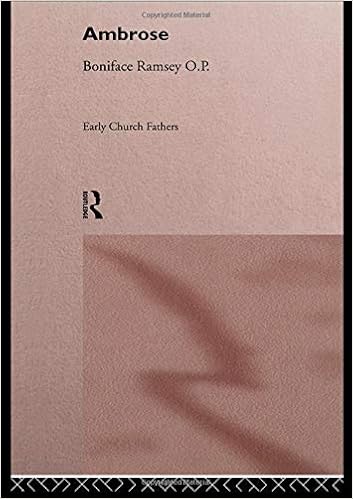
Want to read more about him?  The best you can find is Ambrose by Boniface Ramsey. US HERE – UK HERE
I also have several old PODACAzTs in which I speak of Ambrose. HERE

There’s not a single bishop alive today who can vaguely approach Ambrose for either brains or b****.  Shall we see his like again?

Posted in Patristiblogging, Saints: Stories & Symbols | Tagged | 3 Comments

Daily Rome Shot 1500

Welcome registrants:

Karine
latinritecatholic

Please remember me when shopping online and use my affiliate links.  US HEREWHY?  This helps to pay for health insurance, utilities, groceries, etc..  At no extra cost, you provide help for which I am grateful.
 

And THIS is one example of why you should read the BOOKS before you see the movies.

Black to move and mate in 4.

NB: I’ll hold comments with solutions ’till the next day so there won’t be “spoilers” for others.


Posted in SESSIUNCULA | 1 Comment

Your Sunday Sermon Notes – 2nd Sunday of Advent – 2025

Too many people today are without good, strong preaching, to the detriment of all. Share the good stuff.

Was there a GOOD point made in the sermon you heard at your Mass of obligation for this 2nd Sunday of Advent?

Tell us about attendance especially for the Traditional Latin Mass.

Any local changes or (hopefully good) news?  A taste of what I offered at 1 Peter 5 this week:

[…]

The Forerunner’s question, however, has long raised perplexity. Did John doubt? How could the one who leapt in the womb at the presence of Christ, who baptized Him and pointed to Him as the Lamb of God, now falter? St. Gregory the Great resolved this by considering the order of events. When free beside the Jordan John proclaimed Christ boldly. Yet once he had been cast into prison, Gregory says, John desired to know whether Christ would enter personally into the realm of the dead. Gregory writes, …

[…]

Posted in Sermons | Tagged | 8 Comments

ADVENTCAzT 2025 – 08 – 2nd Sunday of Advent

A 5 minute daily podcast to help you in your Advent 2025 preparation.

Pius Parsch show how this Sunday, this week, focuses on Jerusalem, which is symbolic.

We hear about the second week from  Advent and Christmas with the Church Fathers: a seven week Retreat on the Mystery and the Meaning of the Incarnation.

Yesterday’s podcast HERE.


Posted in ADVENTCAzT, ADVENTCAzT, PODCAzT | Tagged , , , | 1 Comment

ADVENTCAzT 2025 – 07 – Saturday 1st Week of Advent

A 5 minute daily podcast to help you in your Advent preparation

The striking figure of St. Nicholas
Jesus, Son of Mary
Linking Advent and illness

Yesterday’s HERE

Posted in ADVENTCAzT, ADVENTCAzT, PODCAzT | Tagged , , , | 2 Comments

Daily Rome Shot 1499

The last vestige of the sad little Church of Sts. Simon and Jude in Rome off the Via dei Coronari,

And…

And…


Posted in SESSIUNCULA | 5 Comments

ADVENTCAzT 2025 – 06 – Friday 1st Week of Advent

A 5 minute daily podcast to help you in your Advent preparation

  • Today we hear about an approach to putting up the manger scene and the Christmas tree.
  • Card. Bacci warns against activism.
  • Fulton Sheen on God-life.

You hear a bit of “Prayer To A Guardian Angel” from the album LUX by Voces8. HERE

Posted in ADVENTCAzT, ADVENTCAzT, PODCAzT, SESSIUNCULA | Tagged , , , | 1 Comment

Daily Rome Shot 1498 – URGENT VIDEO WHICH FIGHTS AGAINST BOTH *STUPID* AND *HERESY*

Photo from The World’s Best Sacristan™.

I’ll just put this here.

YouTube thumbnailYouTube icon

White to move and mate in 4.

NB: I’ll hold comments with solutions ’till the next day so there won’t be “spoilers” for others.

BONUS SHOT

Posted in Our Catholic Identity, Our Solitary Boast | 8 Comments

ADVENTCAzT 2025 – 05– Thursday 1st Week of Advent

A 5 minute daily podcast to help you in your Advent preparation

Today, we hear that the Church is perhaps bigger and smaller than we think.
Fr. T explains how we will be judged by Christ in his humanity.

Published by TAN:  Advent and Christmas with the Church Fathers: a seven week Retreat on the Mystery and the Meaning of the Incarnation.

You hear also the Benedictine nuns of Gower Abbey, the Benedictines of Mary, Queen of Apostles.

Click

US HERE – UK HERE

Posted in ADVENTCAzT, ADVENTCAzT, PODCAzT | Tagged , , , | Comments Off on ADVENTCAzT 2025 – 05– Thursday 1st Week of Advent

Final Considerations of the 2nd Study Commission on the Female Diaconate

The issue of female diaconate has been effectively deep-sixed by the second commission set up by Francis.   The first commission was historical and this one was more theological.  The first said, there isn’t conclusive evidence of female diaconate (so… no!).

The conclusions of the second committee were issued to in a letter to Pope Leo, including the votes on the various theses they discussed.

The letter, in sometimes impenetrable Italian, signed by Card. Petrocchi, is found in today’s “Bollettino“.  After the breakdown of the voting, there are Final Considerations.  To wit (with my emphases and comments):

I add a personal comment after having carefully informed myself (also thanks to the contribution of my collaborators) on the main conceptual trends emerging in the vast material as well as in the texts drafted by the various Commissions.

The body of documentation, compiled by the various successive Commissions, demonstrates an intense theoretical and existential dialectic [sharp disagreement] between two theological orientations (as is also demonstrated by the results of some of the Commissions’ votes). One of them insists that the ordination of the deacon is ” ad ministerium ,” not ” ad sacerdotium “: this factor would open the way to the ordination of deaconesses. The other, however, insists on the unity of the Sacrament of Holy Orders, [affirmed by the Second Vatican Council in Lumen gentium] along with the spousal significance of its three degrees, and rejects the hypothesis of a female diaconate. It also notes that if the admission of women to the first degree of Holy Orders were approved, their exclusion from the other degrees would be inexplicable. [Which is the true goal of those who want deaconettes.]

The pronouncements of these opposing theological “schools” and the lack of convergence on fundamental doctrinal and pastoral polarities motivate, in my opinion, the maintenance of a prudential approach to the issue of women diaconate. This approach should be supported by increasingly well-equipped, global investigations, aimed, with farsighted wisdom, at exploring these ecclesial horizons. [The Italian is hilariously thick, probably because while at the same time as the writer is trying to say “No, women can’t be ordained” out of the other side of his mouth he is saying, “But we should continue to study the question anyway.”  Thus, the can has been kicked, which fools nobody.]

In this context, it seems essential, as a prerequisite for further discernment, to encourage a rigorous and broad-based critical examination of the “diaconate itself,” [“Heck! What is ‘diaconate’, anyway?”] that is, of its sacramental “identity” and its ecclesial “mission,” clarifying certain structural and pastoral aspects that are currently not fully defined. In this “diakonia to the truth,” the Church must act with evangelical “parrhesia,” [In other words, “No.”] but also with the necessary freedom of evaluation and transparency of discourse.  [So go ahead and keep talking if you want.]

It should also be noted that in many dioceses around the world the ministry of the diaconate does not exist, [That is to say, whether women can be ordained as deacons is a “first world problem”.] and on entire continents this sacramental institution is almost nonexistent. Where it does exist, the activities of deacons often overlap with roles proper to lay ministries or altar servers in the liturgy, raising questions among the People of God about the specific meaning of their ordination. [In other words, do we really need lots of permanent deacons?  And if maybe we don’t, why have women doing those things?]

It should also be emphasized that the various Commissions were unanimous in highlighting the need to expand “communal spaces” [whatever that means] so that women can express adequate participation and co-responsibility in the Church’s decision-making bodies, including through the creation of new lay ministries. [Yeah, that’ll really solve the problems the Church faces today.]

At the end of these Considerations, I believe it is important to underline that the Commission insisted on the urgency of valorizing “baptismal diakonia” as the foundation of any ecclesial ministry.  [See??!?  It’s baptism that counts!]

In this framework, the “Marian dimension” must be ever better understood and developed, as the soul of every “diakonia” in the Church and in humanity. [NB: Mary was not chosen by her Son or the Apostles to be a priest or a deacon.]

So, even while kicking the can down the road another time, the Commission has pretty much said, “Nope, it shouldn’t be done.  Imprudent.  Too confusing.  Not really an issue in most of the world.  But keep talking if you want.  Meanwhile, baptism means we should serve each other!”

Posted in The Drill | Tagged , , | 26 Comments