“Shut up, pray for the man, keep doing your thing and stay out of sight. Winter is not over. The wolves are not dead yet.”

I have a text group which includes very bright, highly credentialed men, of high caliber and “work” experience, including a religious, curial official, rooted Roman, etc.

This is something that appeared today in the “stream”. I’ve edited it and pasted it together for the sake of giving advice to “trads” who can be – we must admit it – sometimes their own worst enemies. It is hard to blame most of them (some I DO) because they’ve been so beaten on, badly treated, that at the twitch of an abusive … let’s confine this to bishop… they flinch and lash out.

I take this to be sage advice.

The understandable sense of relief felt by many is setting some up for bitter frustration because they have turned relief into expectations. And expectations lead easily to pressuring for things supposedly guaranteed to happen while they are just wishful thinking. In other words, the Devil is or may be setting up some commentators and the trad blogosphere for what they do best: creating more hostility towards liturgical sanity and doctrinal orthodoxy and for being a bunch of nagging fools. I say: “Shut up, pray for the man, keep doing your thing and stay out of sight. Winter is not over. The wolves are not dead yet.”

ANOTHER: Agreed, beware hysteria.

The best way we have, the only one in fact, to help the new Pope is to pray and fast for him and for the Church, to strive to be better Catholics, to be the opposite of modernists not only doctrinally but also humanely. If he doesn’t behave like the other one – shouldn’t take much – there is no reason to pressure him and the good guys around him into hating you because you want to see your (often childish) agenda implemented by them NOW. There is no reason to create a Prevost mythology about how good he was all his life. The only reason they have forgotten what was being said about the “most likely candidates” barely TEN days ago is precisely that sense of relief. We have Francis PTSD. And like veterans with it they risk putting everybody into situations that reinforce the PTSD because it is the only world we have become capable to live in.

I am enriched by the perspective – decades of experience at high levels in Rome.

There’s much to mull over here.

By now, I’m one of the longest functioning clerics in internet work (since 1992).   I worked in the PCED.  I’ve paid my dues over three pontificates precisely in this matter of traditional sacred worship.  Over the last few years, we seen newcomers rise up, especially with interminable videos, who fan the flames in a way that isn’t healthy.

Right now, it would be a good idea to sacrifice CLICKS for prudence and the long term. I say to them….

Aut tace, aut loquere meliora silentio.

I don’t expect this of 99% of the readership here, who are so well-meaning and dear to me, but if you are one of those flame fanning video makers out there and you cannot instantly render that Latin into smooth English without looking it up, perhaps you should pipe down a little.   Even if you can… especially so… you should!

The combox is CLOSED.

UPDATE:

From an SSPX priest friend:

>>I agree with everything you just said…. This is an important message. Even the SSPX attitude is pray, watch, and see. Expecting Peter the Roman and being upset when he doesn’t materialize is stupid and self-defeating.<<

Perspective and experience matter.

Posted in "How To..." - Practical Notes, The future and our choices, The Id of Traddydom | 1 Comment

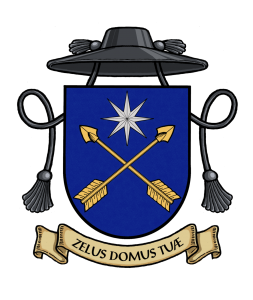
Peter.. keys.. net… coat of arms… regnal name.  Yeah.

Leo XIV’s “Fisherman’s Ring” for the beginning of his pontificate. Not bad. A0

Yeah… okay.  I would like in the future perhaps one of this design but a bit more refined.

Peter.. keys.. net… coat of arms… regnal name.  I would enjoy larger or if it had an emerald this size of a Roman strawberry (in season) or a Gerrett Popcorn kernel, but I’ll take it.

I would like this to be the fast version.  Now get another, more refined, more precise, less like something that – daje – Papa Montini might consider.

Posted in Leo XIV | Tagged | 13 Comments

4th Sunday after Easter (Vetus Ordo): St. James, anger, and your

Our look into the first reading for Sunday’s Holy Mass in the Vetus Ordo of the Roman Rite continues with the Epistle for the 4th Sunday after Easter which is from the Letter of the Apostle St. James.

James is one of the “Catholic Epistles”, non-Pauline texts, along with 1 and 2 Peter – the second of which we’ve been occupied for the last few weeks – 1, 2 and 3 John, and Jude.  The are “Catholic” because they were written to anyone reading them rather than to a specific community, such as Paul’s Letters to the people of Corinth.  James starts in 1:1: “James, a servant of God and of the Lord Jesus Christ, to the twelve tribes in the dispersion…”.  The “dispersion” is also called the Diáspora, from the Greek día, “between, through, across” and the verb speirô, “I sow, I scatter”. Hence, diasporá is “a scattering around”.  Note the different syllabic emphasis between the Greek and how we say it when speaking English.  The bottom line is that James was written for wide circulation anywhere Christians, Jewish Christians especially, might be.

Who was the author, James?  We have two Apostles Jamses, the Greater and the Lesser, “Big” and “Little”.

It is probable that James the Less was either short, or younger than the other Apostle James, or both.   James the Greater was the brother of John, both being Sons of Zebedee.  The author of James is James the Lesser.  He was a son of Alphaeus and a relative of Christ. Matthew’s father was also named Alphaeus, so it is possible that Matthew and James the Less were brothers.  He is called “brother of the Lord”, but “brother” can and does mean extended family, cousin in this case, his mother being not Mary, Mother of Jesus, but Mary the wife of Clopas who was at the foot of the Cross with Mary the Mother of Jesus (John 19:25). Clopas was, according to the ancient writer Hegesippus, the brother of Joseph and father of Simeon who became the second Bishop of Jerusalem.  James the Less, however, was chosen to be the first Bishop of Jerusalem.  It is said that he was very austere and prayed so much that his knees were like those of a camel.  In 64 AD he was accused by the Pharisees, stoned, and when that didn’t do it, killed with fuller’s clubs.  His relics are venerated in the Roman Basilica of the Twelve Apostles and his traditional calendar Feast, with St. Philip.

One of the main points James will make in his letter is about the necessary coherence between belief, identity and action, outward behavior.  Let’s see the reading, which you might read aloud:

[Dearly beloved:] 17 Every generous act of giving, with every perfect gift, is from above, coming down from the Father of lights, with whom there is no variation or shadow due to change. 18 In fulfillment of his own purpose he gave birth to us by the word of truth, so that we would become a kind of first fruits of his creatures. 19 You must understand this, my beloved brothers and sisters: let everyone be quick to listen, slow to speak, slow to anger, 20 for human anger does not produce God’s righteousness. 21 Therefore rid yourselves of all sordidness and rank growth of wickedness, and welcome with meekness the implanted word that has the power to save your souls.

As Peter stressed, there are ways to lose the perfect gift from above that Christ won for us.  Do not forgive others and you will not be saved.  Stick to wickedness and you will not be saved.

Forgive and embrace the Word.

We can walk through this pericope, this cutting of Scripture for use in the Mass.

What first strikes us is that we have a description of gifts.  In your handmissals or in what you hear read from the pulpit, you might hear “every good gift” or “best gift” (pasa dósis agathé) and then every “perfect gift” (pan téleion dórema) which is “from above”.  We might take the good gifts (from above) to be the natural gifts of, first and foremost, our intellect and will, but also life itself, food, health, means of living in this worldly life, etc.  Every perfect gift (from above) could be the gifts of grace, habitual and actual, and the theological virtues of faith, hope and charity, along with the sacraments and the Church which are necessary for our eternal life.  These gifts are from “the Father of lights”, which again might be distinguished as the lights made at the time of creation as well as the spiritual lights that come from the indwelling of the Holy Spirit and the illumination that comes from the Church.  Christ is, of course, the “Light from Light” who enlightens and enlivens.  As in the Prologue of John’s Gospel, “In him was life, and the life was the light of men” (v. 4).

James goes on, “there is no variation or shadow due to change.” God is, of course, unchanging in His very nature.  Were God to be variable, He wouldn’t be God.  Also, this seems to reflect, to use a light image, John’s Prologue: “The light shines in the darkness, and the darkness has not overcome it.”  Shadow and change are juxtaposed to light and perfection.

This has implication for us, who are both His images and His members, Christians: “In fulfillment of his own purpose he gave birth to us by the word of truth, so that we would become a kind of first fruits of his creatures.” He “gave birth” to us through the “word of truth”.  As earthly children resemble their parents, so spiritual children of the Father brought into sonship in Christ must resemble God.   How can we be perfect and like God?  By our also being “unchanging”, in the sense at least of persevering in prayer and good works, forgiving when wronged.

There follow some of the practical conclusions of this line of thought.  James gives excellent advice about being, “quick to listen, slow to speak, slow to anger”.  Such wisdom in so few words.  In the confessional I have often remarked to penitents, and I apply this to myself, that we could avoid a lot of sins by keeping our mouths shut.  We could avoid sins by not immediately assuming bad will or, even if something is done to us out of bad will, maintaining our God-give-from-above reason.  We can also avoid provoking others to sin, which is a serious failure of charity on our part.

We might linger for a moment over that “anger” point.  James wrote, “human anger” which in Greek is orgé andròs, the “anger of man”.  Again a contrast with what is natural, merely, and what is more perfect, the way God can be angry and the sort of anger which Christians are to use, over and above merely human anger.  Psalm 4:4 says: “Be angry, and do not sin; ponder in your own hearts on your beds, and be silent.”  In Ephesians 4:25-27:

Therefore, having put away falsehood, let each one of you speak the truth with his neighbor, for we are members one of another. Be angry and do not sin; do not let the sun go down on your anger, and give no opportunity to the devil.

Again, Ps 4:4, but together the time imagery of the bed, sunset, and the conclusion of a day, for the night and its darkness is when the Enemy of the soul can go to work.  Not that Paul roots acceptable anger in truth only, but truth in communion with each other, connectedness, which implies charity and the desire for the other’s good.

There is a phrase attributed to St. Augustine of Hippo, namely, that “the virtue of hope has two beautiful daughters, anger and courage: anger with the way things are, and courage to change them for the better.”

C. S. Lewis wisely noted that an anger that causes one a dark pleasure is false, as in “the fact that one feels entirely righteous oneself only when one is angry. Then the other person is pure black, and you are pure white.”  This is not, of course, the path to truth or righteousness.

Pope St. Gregory the Great said: “We must beware lest, when we use anger as an instrument of virtue, it overrules the mind, and go before it as its mistress, instead of following in reason’s train, ever ready, as its handmaid, to obey.”

We are called to use anger properly, at the right time, for the right reason, in the proper measure.  To suppress being angry when one ought to be is also wrong.  Such a challenge should leave us wary and humble and, of course, repentant about our past failings concerning expressions of anger and their fallout, including the provocation of others, not to conversion, but to sin.

Posted in The Drill, WDTPRS | 1 Comment

ROME 25/5– Day 37: hard choices

5:46 – this was sunrise

20:28 – this will be sunset

20:45 – this is for the Ave Maria Bell

St. Paschal Baylón is remembered on his feast day.  He was a model of perseverance in pursuing his vocation.  He also declined to be pushed into a vocation he did not think he had.   He served as a Franciscan brother in the capacity of porter and official beggar.

Beautiful sky and light in the Piazza Navona last night.  I had gone to the P.za der Fico to view some of the ongoing chess games.  It is interesting that, although they have some space, they only set up one or two boards and play bullet (5 minute) while a lot of them sit or stand around and constantly comment, even sometimes reaching out and poking at squares or pieces.

Speaking of things papal.  At Sant’Agnese in Agone, they never did change the coat of arms over the main door.  But the other guy is above the left door while the titular cardinal is over the right.

Breakfast.

Shopping for lunch.  So hard to choose.

I got some mortadella and pizza bianca, but not much.  I am slated to be out tonight.

From Ariccia, famous for porchetta.

In chessy news…

White to move and mate in 4.  HERE

Bonus shot:

On the P.za Navona there is a trinket store which has a lot of chess sets, pottery, trashy stuff, some good things.  They have different packs of cards from different regions in Italy for different, regional games.  For example, they have the Neapolitan deck used in Rome and elsewhere for games like Briscola and Scopa.  The other decks are a mystery, other than the Piacentina, which can be used for the same games.   You can click for larger and see the names/places on the decks.


Posted in SESSIUNCULA | 1 Comment

ROME 25/5– Day 36: Caponata

On this Feast of St. John Nepomuceno the sun came into view at 5:47.   We will lose sight of it again at 20:27.

Our ears will not hear the un-run Ave Maria Bell at 20:45 in the Roman Curia, but it does ring at the proper solar time at The Parish™, Ss. Trinità.

We had a proper for St. John Nepomuceno today in the special texts for the Diocese of Rome.

Anyone want to take a shot at this and provide an accurate and yet smooth version in English?   This is a powerful prayer with a fine reminder and a mighty petition.

Welcome registrants:

Nolmendil
StellaFidei

At Amazon, 35% off on some things starts today for Memorial Day. Hence, my reminder…

Please remember me when shopping online and use my affiliate links.  US HERE – UK HERE  WHY?  This helps to pay for health insurance, utilities, groceries, etc..  At no extra cost to you, you provide help for which I am grateful.

This is pretty cool.

I was out to supper last night with two readers from the States.  Sicilian.

Wonderful caponata.

Pasta alla Norma.

In the market this morning after getting a haircut. Stacked fennel.

Hint: Get some fennel, peel off the leaves and try it raw as an appetizer, dipping it in good (preferably homemade) mayonnaise.  The outter leaves have to go, of course, but the inner are great down to the core.   Fennel is wonderful baked, like au gratin.

In chessy news, in Bucharest my guy Wesley dropped a game to young Pragg (aka Praggnanandhaa Rameshbabu, therefore “Pragg”).  I was watching the video, skipping forward to the parts where the commentators were focused on their game.  (The whole thing was well over 5 hours, otherwise).  I must admit that I was puzzled about what my guy was thinking toward the end.  It might have been time pressure, but I had thought that it was his game to win, but not after 29. g3. Pragg had black and played the Benko Gambit, which seems not to be much in vogue. Anyway, today Pragg is in 1st place.

Posted in SESSIUNCULA | 7 Comments

Concerning the Pope’s… Popes’… pectoral Cross

This is a new Cross…

Posted in Just Too Cool | Tagged , | 7 Comments

ROME 25/5– Day 35: The papal “We”?!?

The Eternal City became noticeably brighter with the rising of the sun at 5:48. The light will diminish significantly at 20:26.

The Ave Maria Bell is in the 20:45 cycle right now.

It is Feast of St. Jean Baptiste de la Salle in the older calendar and of St. Isidore the Farmer in the newer.

Welcome registrants:

DeaconRP
sm1367

Please remember me when shopping online and use my affiliate links.  US HERE – UK HERE  WHY?  This helps to pay for health insurance (massively hiked for this new year of surprises), utilities, groceries, etc..  At no extra cost, you provide help for which I am grateful.

Here’s something to give hope to those who love the Church’s Traditional Roman Rite:

Pope Leo XIV to Eastern Churches in his Wednesday Audience:

“How much we need to recover the sense of mystery, so alive in your liturgies, which involve the human person in his totality, sing the beauty of salvation and inspire wonder at the divine greatness that embraces human smallness! And how important it is to rediscover, even in the Christian West, the sense of the primacy of God, the value of mystagogy, of incessant intercession, of penance, of fasting, of weeping for one’s own sins and those of all humanity (penthos), so typical of Eastern spiritualities!”

“…mystagogy, of incessant intercession, of penance, of fasting, of weeping for one’s own sins and those of all humanity…”

Come to think of it, those are also present in the TRADITIONAL ROMAN RITE.  Not so much in the Novus Ordo, however.  I wonder how we could recover those highly desired things?   Hmmm…

The West, the Latin Church, does not need to adopt Eastern Rites to recover a sense of mystery.  We have all of that in our traditional Roman Rite.  That’s what the ROMAN Church needs to recover.   In our own ways, the Rites of our Churches convey these necessary elements.

Meanwhile, Card. Müller told AP:

“We cannot absolutely condemn or forbid the legitimate right and form of the Latin liturgy,” Mueller said. “According to his character, I think (Leo) is able to speak with people and to find a very good solution that is good for everybody.”

And also, it seems that Leo XIV, while he closed out his previous Twitter account, is using the @Pontifex account.  He tweeted a message in Latin HERE:

Pax vobiscum omnibus! Haec prima salutatio est Christi, Boni Pastoris, post Resurrectionem. Ipse salutatio haec velim cor vestrum ingrediatur et familias vestra omnesque homines, ubicumque sint, cunctosque populos et universum terrarum orbem attingat.

Peace to you all!  This is the first greeting of Christ, the Good Shepherd, after the Resurrection.  I myself wish that this greeting enter your hearts and your families and all men wherever they may be, and reach all peoples and the whole world.

I’m happy for the Latin, though I have a question about it.  “vestras“, right?

I am somewhat gobsmacked by the appearance on the Vatican website of a LATIN version of Leo XIV’s address to Cardinals in the Sistine Chapel.  HERE

After the dearth of Latin in the last years, the guys in the Latin Letters office must be a little perked up!  What really grabbed my attention what Leo’s use of “We”.  For example…

Peculiarem in modum Deus insuper, per vestra suffragia ad Primo Apostolorum succedendum cum Nos vocet, hunc thesaurum Nobis committit, ut, eo iuvante, fideles [sic] simus administrator…

Moreover, in a special way God, through your votes, when He calls Us to succeed to the First of the Apostles, commits this treasure to Us, so that, with His help, We may be a faithful steward….

I think that should be “fidelis“, since – although he is using “We” – he remains one person.

The “We” is not in the Italian version.  They haven’t, at the time of this writing, posted English.

In chessy news…

In Bucharest, my guy Wesley is in a tie in the middle of the pack.   He drew yesterday against world champ Gukesh.  Only Nodirbek had a decisive game.

Black to move and mate in 4.  HERE

Posted in SESSIUNCULA | 20 Comments

ROME 25/5– Day 34: Heat death of the universe

On this Feast of St Michele Garicoïts, the Sun rose at 05:49 and it will set at 20:25.

Pushed by the ever later sunset, the Ave Maria Bell, which you know know all about (more than you wanted to know) should ring for the Curia at 20:45.

I was sent a link to news that the heat death and total stillness of the known cosmos is now projected to happen in 1078 years rather than in 101100 years.   HERE   Entropy.

That would indeed someday be the fate of the cosmos if it were not for …

The Resurrection of the Lord put death to death.  Someday He will return, the cosmos will be unmade in fire, Christ will take to Himself all things and submit them to the Father and God will be all in all.

In the meantime, start making adjustments for that rapid speed up.

Speaking of resurrections, Major League Baseball has reinstated some players previous banned totally from organized ball including Pete Rose and “Shoeless” Joe Jackson.  HERE  Rose was banned for betting on games and Jackson for being part of the 1919 Chicago “Black Sox”.

Please remember me when shopping online and use my affiliate links.  US HERE – UK HERE  WHY?  This helps to pay for health insurance (massively hiked for this new year of surprises), utilities, groceries, etc..  At no extra cost, you provide help for which I am grateful.

BTW… I don’t believe I mentioned that I read the newest book by Michael D. O’Brien.

Letter to the Future: A Novel

It’s quite good and I recommend it. Long after the fall of modern Western civilization, the result of increasing totalitarianism and a supernatural illumination event, some children find a hiding place with things from before including a written manuscript recounting what happened. It is also not as long as some of O’Brien’s earlier efforts. Perhaps he has an editor now.

Black to move and mate in 4.

NB: I’ll hold comments with solutions ’till the next day so there won’t be “spoilers” for others.

Priestly chess players, drop me a line. HERE

Also, I am a chess.com affiliate. Sign up!

Support the monks of Le Barroux!  Good wine for you, help for them.

OPPORTUNITY
10% off with code:
FATHERZ10

Posted in SESSIUNCULA | 13 Comments

ROME 25/5– Day 33: languid

Sunrise in Rome was at 5:50 and sunset will be at 20:24.

The Ave Maria is in the 20:45 cycle.

It is the traditional Feast of St. Robert Bellarmine and the Feast of the Dedication of Santa Maria “ad Martyres” (the Pantheon) in 609.

‘Tis also the Feast of Our Lady of Fatima.

Welcome registrants:

blackscholescat
Catulus domini
Hillbilly Pappy
Speculum Iustitiae

In Afghanistan, the Taliban has outlawed chess because they consider it to be gambling.   This was a problem in the Church for a while, too.  For some time, chess also used dice!  Games of chance were forbidden for clerics and religious, but many simply played anyway, including St. Teresa of Avila, who cites chess imagery in Interior Castle and who is the Patron Saint of Chess Players.  A couple of the more famous openings for white are named after priests, the Ruy Lopez (aka The Spanish) and the Ponziani (after a priest who became Vicar General of Modena and with two others a member of the so-called Modena School of Chess, in vigore after Philador).

Lunch today, nothing special.  I made a sauce with garlic, hot pepper, and fresh basil.  I like “fat” spaghetti.  Easier to get here.

Supper… after a couple of days of eating out, salad.  The dressing: macerate cherry tomatoes with salt, white wine vinegar, finely chopped garlic.  Crunchy and soft, salty and sweet.  Red wine: cesanese.  I have some gorgonzola and a pear.

Priest have asked if on Sunday they can add a collect for the new Pope under one conclusion.  Yes. You can.  And you should!

The entrance to my very humble (not Casa Marta humble) abode.  I’m the second door on the left.

Tired again.

It’s like… this huge weight is gone and now I just want to rest, sleep, be normal without the worries of the Stasi fueled by lunatic catholic “New Red Guards” who for years have been on my case trying to ruin my life.   Today was rainy so I basically just slept a lot.

Posted in SESSIUNCULA | 11 Comments

ROME 13 May 609 – Exorcism, screaming demons, terrified people fainting – Dedication of the Pantheon as a church

Dear readers, this is the sort of thing that Popes do!  They fight against the forces of Hell and they work for the salvation of souls.

When the ancient obelisk that was in the Circus of Caligula off to the side of St. Peter’s Basilica was moved to the center of the piazza in 1586, Pope Sixtus V caused to be inscribed on its base words from the Rite of Exorcism.  And he exorcized the thing to stand against the approach to the basilica of demons and the possessed.  Priests were asked to repeat the words from the exorcism as they approached.   Pope Sixtus took a pagan thing, exorcized it, and made it a bulwark against the demonic.

That was then.

In 2019 a demon idol  was brought into the Basilica and placed on the ALTAR over the bones of the first Vicar of Christ.

Here’s another things Popes do.

In 609 Pope Boniface IV took a pagan thing… the pagan thing… the Roman building dedicated to “all the gods… pan-theon” (aka demons) exorcised it and made it into a church!

This is the pattern, by the way.  One might say, “This is the way.”

Before things are consecrated, they are exorcized.

There is a constant supernatural battle going on around us, between the holy angels and apostate demons.  We have many helps in this battle, including sacramentals and, especially, the sacraments.

One sacramental is the Rite of Exorcism.  There are “major” exorcisms and “minor”.  Exorcisms can be done over people, things and places.

Church buildings ought to be exorcized inside and out before they are consecrated.  In the traditional rite of the consecration of a church, first, the building is exorcized at three ascending levels, each with a procession around the building (in the same pattern/direction, btw, as the priest swings incense in circles over the gifts on the altar at the offertory).  The process is repeated inside the church.  Only then are the faithful allowed to enter.

THAT’s “pastoral”!

(For you libs, so you can understand, pástoral is a more serious version of your “pastóral” or, in extreme cases, “pastóreeal”).

In 609 the Emperor Phocas gave the magnificent ancient Roman Pantheon, the temple to “all the gods” to the Church.

Pope Boniface IV got rid of all the pagan stuff and consecrated it to the Mother of God and the martyrs on this day, 13 May.

Of course before anything is to be consecrated, it first had to be exorcized. This is especially the case with a pagan temple that had been dedicated to demons.

We have an account of the exorcism of the Pantheon before it was consecrated this day.  In Italian HERE.

“In 608 the Byzantine emperor Phoca gave [the temple] to Pope Boniface IV and there was organized an evocative ceremony to consecrate it to the Christian God.   On 13 May 609 a huge crowd gathered near the Pantheon to witness the event. Chronicles recount chaos and chilling screams that were felt from within: the pagan demons were aware of what was about to happen. The doors were thrown open and the Pope, in front of the entrance, began to recite the formulas for the exorcism. The screams from the idols increased in intensity, and the commotion deafened the ears of the onlookers.  Fear gripped the crowd and no one was able to stand on their feet, looking and hearing that terrible spectacle. Only Boniface IV resisted and, undaunted, prayed and consecrated the Pantheon to Christ. It is said that the demons left the ancient temple chaotically and with a great din, fleeing from the open “eye” of the dome or from the main doors.  Once the ceremony was over, the Pope dedicated the building to the Madonna dei Martiri, in memory, perhaps, of the many Christians killed in honor of those filthy idols … “

There was also a vision of Catherine Ann Emerich:

One of the visions of Bl. Catherine Emmerich was precisely about the exorcism and consecration of the Pantheon: “…  I saw again the whole ceremony of the consecration of the temple: the holy martyrs assisted with Mary at their head.  The altar was not placed in the middle, but was was up against the wall.  I saw carried into church more than 30 carts of holy bones.  Many of these were put into the walls.  Others could be seen, where there were round holes in the wall, closed up with something that looked like glass. (p. Schmoeger, ‘Vie d’Anne Catherine Emmerich’, tomo III, pp. da 69 a 71)

Battles with the Enemy are fought on many levels.  Let us not forget that demons are territorial and legalistic.

Once they claim a toehold, it requires effort to break their hold and get rid of them from places, things and persons.

Posted in Classic Posts, Hard-Identity Catholicism, Just Too Cool | Tagged , , | 7 Comments